For centuries, the Wielkopolska Region was a hub of milling. Of the roughly 20,000 windmills that once stood in the Polish-Lithuanian Commonwealth, as many as 12,000 were in this region. Today, around 100 have survived, and 50 can be visited along the Wielkopolska Windmill Trail.
Most windmills in the region are post mills, built almost entirely of wood and markedly different from the masonry Dutch-style windmills often depicted in paintings. Their defining feature is that the entire body of the mill sits on a single central vertical post, allowing it to rotate and align with the wind. This clever design greatly improved operational efficiency.
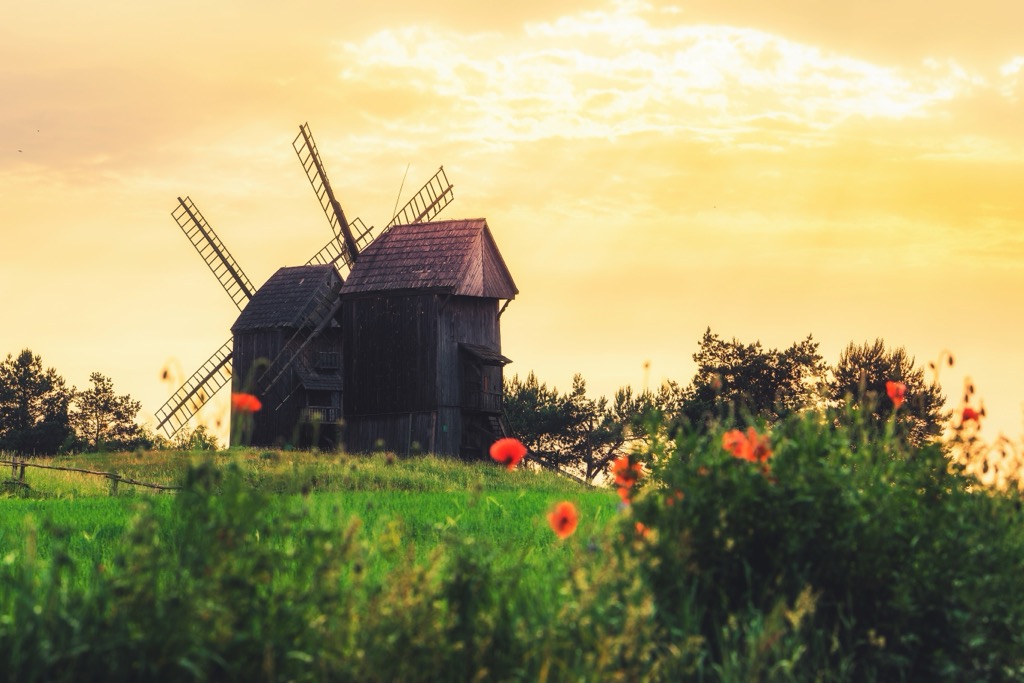
The highest concentration of windmills is in south-western Wielkopolska, around Leszno, Kościan, and Przemęt. The trail begins in Rydzyna, famous for the grand Baroque castle of the Leszczyński family. Nearby, Osieczna hosts the unique Museum of Milling and Agriculture, where visitors can see three historic windmills and one fully functional modern reconstruction. The museum also offers bread-baking workshops and features a café.
A significant concentration of old windmills can also be seen near Kościan and Krzywiń. Of particular interest is the town of Śmigiel. According to local legend, the townspeople aimed to have one hundred windmills; yet whenever the hundredth was nearing completion, one of the existing mills would be destroyed by fire or another misfortune.
The westernmost branch of the Wielkopolska Windmill Trail leads to the Przemęt Landscape Park, known primarily for its pristine lakes and excellent kayaking routes. A must-see is the windmill in Brenno, which has been adapted for accommodation, allowing visitors to spend a holiday in a truly unique setting.


An interesting conclusion to a journey along the Wielkopolska Windmill Trail can be a visit to Wolsztyn. Wolsztyn features only a single post mill, but it stands at the heart of the Open-Air Museum of Folk Architecture of Western Wielkopolska, a fully reconstructed historic village. Beyond the windmill, visitors can explore rural cottages – from the home of a wealthy Olęder farmer to that of a poor farmhand – as well as a village inn that has witnessed much over the years.