Poznań is not only the capital of the Wielkopolska Region and a Monument of History, but also a city full of countless stories and mysterious legends. Its thousand-year-old cathedral, not one but two castles, and the famous billy goats on the Town Hall tower are just a few highlights. Yet true Poznanians insist that the best way to experience the city is to savour a St Martin’s croissant, wander along the streets of Wilda and Jeżyce districts, or, together with friends, take a trip to the zoo to see the monkeys.
Old Town, billy goats, and St Martin’s croissants
The best place to start exploring Poznań is at the Old Market Square. At its centre stands the city’s symbol – the Renaissance Town Hall built in the mid-16th century by the Italian architect Giovanni Battista Quadro. The main attraction here is undoubtedly the famous Poznań billy goats, which butt heads daily at 12.00 and 15.00 on the Town Hall tower, accompanied by the sound of bells, chimes, and the city’s live trumpet fanfare. While the Town Hall no longer serves its original administrative function, it houses the Museum of the City of Poznań.
Adjacent to the Town Hall are the charming merchant houses – small, picturesque tenements with arcades that once hosted trades in herring and candles. Today, they rank among the most photographed historic buildings in the city. Nearby stands the Poznań pillory, a former site of public punishment – a medieval ‘light-and-sound’ display of justice.
From here, it is only a five-minute walk to the Poznań Fara, often called the Baroque pearl of the city. Originally a Jesuit church, it became the main city church after the collapse of the old Gothic parish. Renowned for its extraordinary opulence, it also hosts exceptional organ concerts, played on an instrument crafted by the celebrated organ builder Friedrich Ladegast.


On the opposite side of the Old Town rises Przemysł Hill – legend has it that it was brought here by devils from Silesia – crowned by the reconstructed Royal Castle. Founded as the seat of Duke Przemysł I and later serving as the royal residence of his son, Przemysł II, the castle now houses the Museum of Applied Arts, while its tower offers excellent views over the city.
No weekend in Poznań would be complete without tasting St Martin’s croissants, the city’s sweetest symbol. These croissants are a certified product and can only be baked in Poznań and its surrounding area. Several bakeries around the Old Market Square sell the authentic croissants, and they are also widely available throughout the city. For an in-depth experience, visit the Croissant Museum of Poznań, where an interactive one-hour demonstration reveals all the secrets behind baking these iconic pastries.
Ostrów Tumski
The island on the Warta River in Poznań, Ostrów Tumski, is one of those sites that can truly be described as ‘where Poland began’. In this fortified settlement, Duke Mieszko I erected a stone residence, to which a small chapel was attached – most likely the first Christian church in these lands.
Begin your visit at Porta Posnania, the Interactive Centre for the History of Ostrów Tumski. The multimedia exhibition guides visitors through over ten centuries of Poznań’s history, illustrating the city’s development and the significance of Ostrów Tumski for the origins of the Polish state.

The remains of the ducal residence are now located underground, above which rises the structure of the Church of the Blessed Virgin Mary. The outline of the palatium (the stone residence) is clearly marked by an artistic installation made of tempered glass.
The central point of the island is the Archcathedral Basilica of St Peter and St Paul. Although the contemporary structure is largely the result of post-war reconstruction and is Gothic in style, the twelve chapels surrounding the nave retain their original forms. Of particular note is the Byzantine-style Golden Chapel, which houses the sarcophagus of Mieszko I and Bolesław Chrobry.
A visit to Ostrów Tumski would not be complete without exploring the Archdiocesan Museum, where you can see, among other treasures, one of the oldest monstrances in Poland, founded by Władysław Jagiełło, as well as St Peter’s sword – a gift from the pope to Mieszko I. Slightly further afield lies the Genius Loci archaeological reserve, exhibiting the remains of the island’s former defensive ramparts.
City centre and the Imperial District
To the west of the Old Town lies Poznań’s modern city centre, traditionally organized around Plac Wolności (Freedom Square). The square is surrounded by a number of significant buildings, including the Raczyński Library, the National Museum with its Gallery of Painting and Sculpture, and the Hotel Bazar – the site where the idea of organic work first emerged.
The principal street of this part of the city centre is St Martin Street, named after the medieval settlement of the same name. A remnant of this former suburb is the Gothic St Martin’s Church. The area is also home to Poznań’s oldest cinema, Muza.
Reaching Aleje Niepodległości brings you to the site where, just 150 years ago, the formidable fortifications of the Poznań Fortress once stood. After their removal, a new, representative district was laid out. Its focal point became the Imperial Castle – the youngest royal residence in Europe – accompanied by the Grand Theatre, historic university buildings, the railway directorate, and the main post office. Adjacent to the castle is the Enigma Cipher Centre.

Śródka and Malta Lake
One of the smallest districts of Poznań, yet also one of the most charming, Śródka is connected to Ostrów Tumski by the Bishop Jordan Bridge. The centre of Śródka is a small square with the Gothic St Margaret’s Church. Historically, this square was the hub of small-scale trade; today, it thrives with restaurants and cafés. Here, visitors can also admire the unique three-dimensional mural The Story of Śródka with a Trumpeter on the Roof and a Cat in the Background. Walking from the bridge, look for the street sign for Ostrówek – a remnant of the former town of Ostrówek, once the smallest town in Poland, with barely 100 inhabitants.
On the opposite side of the expansive Rondo Śródka roundabout stands the 12th-century Church of St John of Jerusalem Outside the Walls. Originally established as a hospital church, it was administered by the Knights of Malta.
The nearby artificial Malta Lake derives its name from the order. Along its shores runs the Malta Park Railway ‘Maltanka’, which has been ferrying children and adults alike to the New Zoo for decades. Another major attraction is the Malta Thermal Baths (Termy Maltańskie), one of the largest aquaparks in Poland.

Jeżyce, Łazarz and Wilda
If you have a bit more time, venture beyond the city centre to discover three historic districts: Jeżyce, Łazarz, and Wilda. Each has a distinct character, yet all retain hundreds of historic tenement houses. Here, visitors can find the oldest timber-framed and half-timbered buildings, alongside exceptionally ornate Art Nouveau tenements. Remnants of the districts’ rural past are evident in the three market squares, which continue to serve commercial functions to this day.
Of the three, Jeżyce feels the most intimate; here and there, vestiges of former farm buildings can still be seen. Far more common, however, are tenements whose ground floors now house some of the city’s most interesting cafés and restaurants. Jeżyce is also home to the Old Zoo, which has operated here since 1871. Once known as a cradle of Poznań hip-hop culture, today the district is associated with its thriving gastronomy scene.

The ideal places to begin the exploration of Łazarz are Wilson Park and the Palm House, which boasts a unique collection of plants from around the world. Just a few steps away are some of Poznań’s most impressive tenements, the sort of buildings that would not be out of place in Vienna, as well as brilliantly revitalised former barracks now serving as lofts.
Finally, upon reaching Wilda, the district’s distinct character becomes immediately apparent. It is the most working-class of the three, situated next to the historic Hipolit Cegielski Company. Wilda’s curiosities include small chapels incorporated into the façades of tenements and one of Europe’s largest courtyard within a former workers’ colony. The punk band Pidżama Porno once sang that ‘the devil lives in Wilda’, but that hasn’t been true for a long time. Today, Wilda attracts students and artists.
Wielkopolska National Park
Poznań is one of only two Polish cities where you can reach the nearest national park within just 20 to 30 minutes. What’s more, you don’t even need a car – you can take a train (to Mosina or Puszczykówko station) or hop on a bike, taking advantage of the great trails running from the city center along the Warta River.
Wielkopolska National Park is like Wielkopolska in miniature. Here, you will see all the landscapes characteristic of the region: gentle hills, numerous lakes, mixed forest plains, and riparian woodlands along the Warta. Scattered here and there is an occasional glacial boulder. All of this is the result of the last ice age, which shaped this landscape several thousand years ago.
A few places are particularly noteworthy. It is definitely worth climbing Osowa Góra, one of the highest hills near the city. Located on the edge of Mosina, a tall observation tower stands at its peak. From here, the red trail leads into the heart of the park – perfect for a full-day trip. It leads past several lakes, including the exceptionally beautiful Góreckie Lake. On it lies Castle Island (Wyspa Zamkowa), and on it – as you might guess – the ruins of a castle. It is also worth checking out the WPN Natural History Museum in Jeziory (the building was created as a residence for the Nazi governor, and to this day you can still see concrete guard posts, for example). The trail finishes in Puszczykowo – a garden city.


WPN is also a place of many legends. One of them concerns Napoleon’s Well (Studzienka Napoleona, near Osowa Góra), whose water supposedly tasted like the finest champagne to the Emperor himself.
A place you absolutely cannot miss is the National Museum of Agriculture in Szreniawa, located on the edge of the park. It holds Poland’s largest collection related to the history of agriculture, farming equipment, and rural culture. The exhibits include ancient wooden plows and flails, as well as tractors, agricultural aircraft, steam traction engines, and complete sugar refinery production lines. The museum organizes numerous events, often combined with a craft and organic food fair.
Puszczykowo – Garden City
In the past, Puszczykowo was Poznań’s most popular summer resort. During the season, an excursion steamboat sailed along the Warta, and special holiday trains carried tourists. Today, Puszczykowo is primarily an elegant suburban enclave built according to the garden city concept. That is why taking a stroll through the town and viewing dozens of historic villas – many built in the fashionable Swiss or Tyrolean style – is a great idea. The town’s two railway stations are also kept in this spirit.
A unique attraction, especially for children, is the Arkady Fiedler Literary Museum. The writer and traveler lived in Puszczykowo for most of his life, setting off on expeditions from here, and his house – still inhabited by subsequent generations of his family – is now a museum filled with souvenirs from all over the world.
Zielonka Forest (Puszcza Zielonka)
Poznań’s second “green lung.” This vast forest stretching to the northeast of the city is one of the favorite relaxation spots for Poznań residents. It is ideal for hiking, kayaking, sunbathing by the lake, but above all, for cycling.
The forest is quite large, but many places can be reached by train – to Czerwonak, Owińska, Sława Wielkopolska, and Skoki stations. Trails lead into the depth of the forest from each of them. You can leave your car in one of the many forest parking lots. The lakes are fully accessible, and the shores are undeveloped.
Traversing the entire Zielonka Forest can be a task for several days, but there are a few places we especially want to recommend to you:
- Observation tower on Dziewicza Góra with a brilliant panorama of the Zielonka Forest, surrounding villages, and nearby Poznań
- Former Cistercian convent in Owińska with a beautiful Baroque church, currently the seat of a school and Poland’s only typhlological museum (collecting items related to the culture and education of visually impaired people)
- Forest Arboretum in Zielonka – also a good starting point for further hikes
- Sanctuary in Dąbrówka Kościelna
- Beaches and swimming spots in Tuczno, Kamińsko, and Owińska


The proximity of the forest and the abundance of raw materials led to the creation of many wooden churches in the area, 12 of which have survived to our times. They are all connected by the Trail of Wooden Churches Around Zielonka Forest. It includes the following places of worship:
- Kicin, Church of St. Joseph, Spouse of the Blessed Virgin Mary
- Wierzenica, Church of St. Nicholas the Bishop
- Uzarzewo, Church of St. Michael the Archangel
- Długa Goślina, Church of St. Mary Magdalene
- Węglewo, Church of St. Catherine of Alexandria
- Kiszkowo, Church of St. John the Baptist
- Łagiewniki Kościelne, Corpus Christi Church
- Sławno, Chapel of St. Rosalia
- Skoki, Church of St. Nicholas the Bishop
- Jabłkowo, Church of St. Michael the Archangel
- Raczkowo, All Saints Church
- Rejowiec, Church of the Sacred Heart of Jesus
Steam Train Excursion
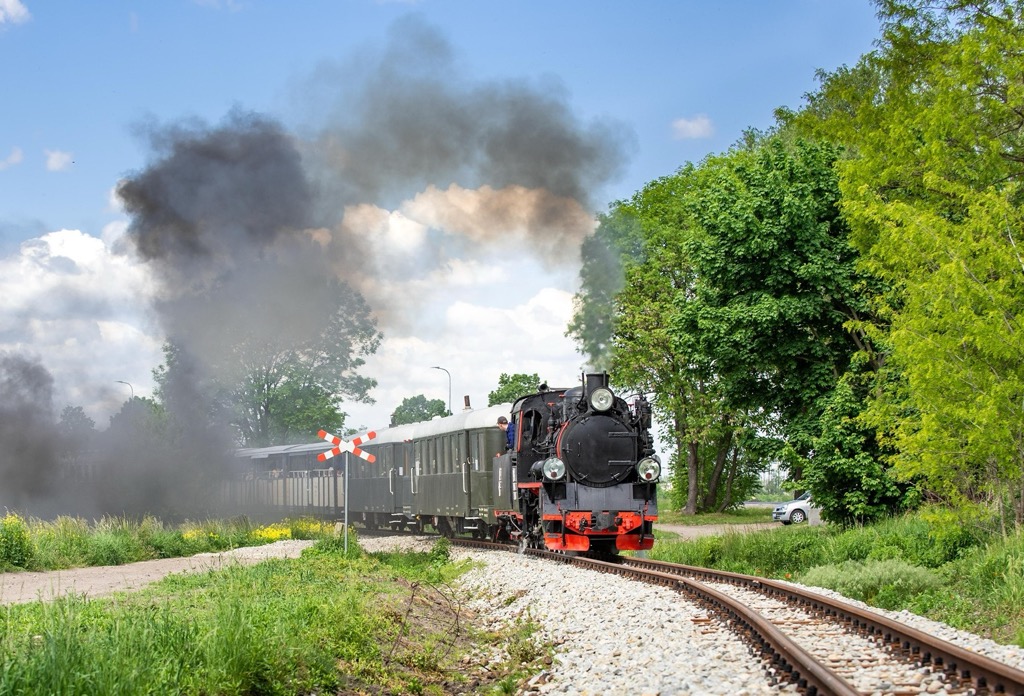
This is one of the last remaining narrow-gauge railways in Poland where you can ride historic carriages pulled by a steam locomotive. Billowing steam and smoke from the chimney, the screech of brakes, and the whistle of a conductor dressed in a somewhat old-school uniform – this is precisely the atmosphere of the Środa County Railway (Średzka Kolej Powiatowa). You can ride it every weekend in spring and summer.
The ride on the route from Środa Wielkopolska to Zaniemyśl takes about an hour and covers around 14 km. The steam train stops several times, so you can even hop out for a moment to take a picture. The stop at Zaniemyśl station is long enough that you can easily go for ice cream or to a bakery, come back, and ride back to Środa. Everything along the route is retro – staff uniforms, station signs, even cardboard ride tickets.
Near the Środa County Railway line are two more attractions worth seeing. The first is Edward’s Island (Wyspa Edwarda) in Zaniemyśl. Count Edward Raczyński had his summer house there. It was also where he ended his life in a rather spectacular way, shooting himself with a cannon. Currently, Zaniemyśl is a place for relaxation with a beach, swimming area, and excellent nearby dining options. The second place is Gzub Brewery (Browar Gzub) in Annopol. However, it is not just a place where they make really good beer! They have a year-round garden and their own campsite there.
Kórnik Castle
This is arguably the best-known castle in Wielkopolska, which should come as no surprise considering its unique architecture, preserved rich furnishings, and mysterious legends associated with the castle.
The form of the castle preserved to this day is thanks to Tytus Działyński, whose intention was to make the family seat a museum and a publicly accessible library. In the mid-19th century, he rebuilt the castle in the English Gothic Revival style with oriental elements.
Behind the castle lies the Kórnik Arboretum, covering 50 hectares, making it the fourth largest in Europe. It is also the oldest arboretum in Poland. It is particularly enchanting in spring during the blooming of lilacs, azaleas, and rhododendrons.

Inseparably linked to Kórnik Castle is the legend of the White Lady (Biała Dama), or Teofila of the Działyński family (Potulicka), who, clad in a white gown, gazes at visitors from her portrait. The story goes that at midnight she steps out of the painting frame and meets a mysterious rider on a black horse in the park.
Rogalin Palace
You enter through an ornate gate, a grand courtyard before you, and at its end a lavish palace that, with its two semicircular annexes, seems to embrace this entire landscape. You can feel like past guests of the Counts Raczyński, the owners of Rogalin Palace. Today, the palace is a branch of the National Museum. Great architecture and beautiful interiors are not all. Rogalin Palace also features a picture gallery, a French garden, an English park with 800-year-old oak trees, and a carriage house. Plan an entire day for sightseeing.
The tour route includes the bedrooms of the owners and their children, the former ballroom converted into an armory, and a phenomenally designed library. Furniture, wallpaper, and other interior elements have been meticulously reconstructed, and the walls are adorned with numerous works of art. The most interesting is the library, which could easily be a set for filming another wizard movie.
The English park, created during the time of Count Edward Raczyński, is known primarily as the place where ancient oak trees grow. The oldest trees are 500, and some even 800 years old! Particularly famous are the oaks named Lech, Czech, and Rus – just like the three Slavic brothers from the well-known legend. The fourth is the Edward oak, naturally named in honor of the count.


Kayaking along the Warta River
Although the Warta is Poland’s third-largest river, it is also a popular kayaking route. Importantly, one of its most interesting sections is right near Poznań. On the route from Radzewice to Puszczykowo, you paddle among Warta wetlands, riparian forests, and in close proximity to ancient oak trees. What is interesting is that despite the proximity of the city, only in one place does any bridge cross the river.
Of course, you don’t need to have your own kayak; many companies operate in the area offering professionally prepared kayak trips.