We suggest a trip with a cumulative elevation gain of 750 metres – quite a challenge in one of the flattest parts of the Wielkopolska Region! Along the way, you’ll see the oldest road sign in this part of Europe, the sixth-largest church in the world, and a budget-friendly local counterpart of Paris’s famous Arc de Triomphe. Welcome to a journey through Konin and Kłodawa, in eastern Wielkopolska.
We recommend setting aside at least three days for this trip, including a weekday (Friday or Monday). This is because the region’s main attraction, the Kłodawa Salt Mine, is open to visitors only on weekdays.
A journey to the centre of the Earth
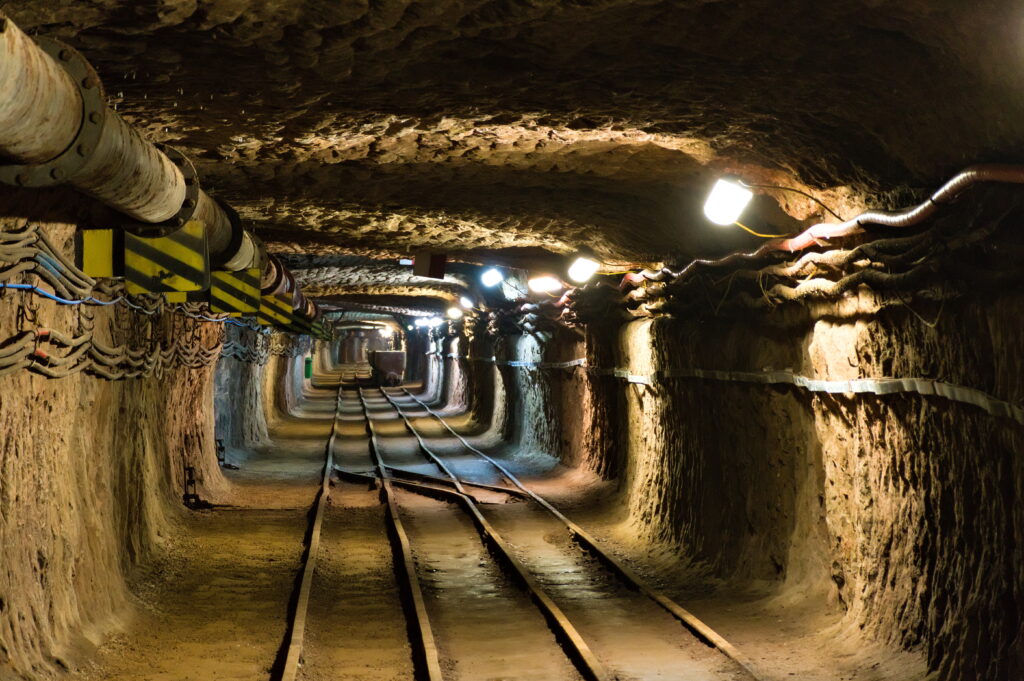
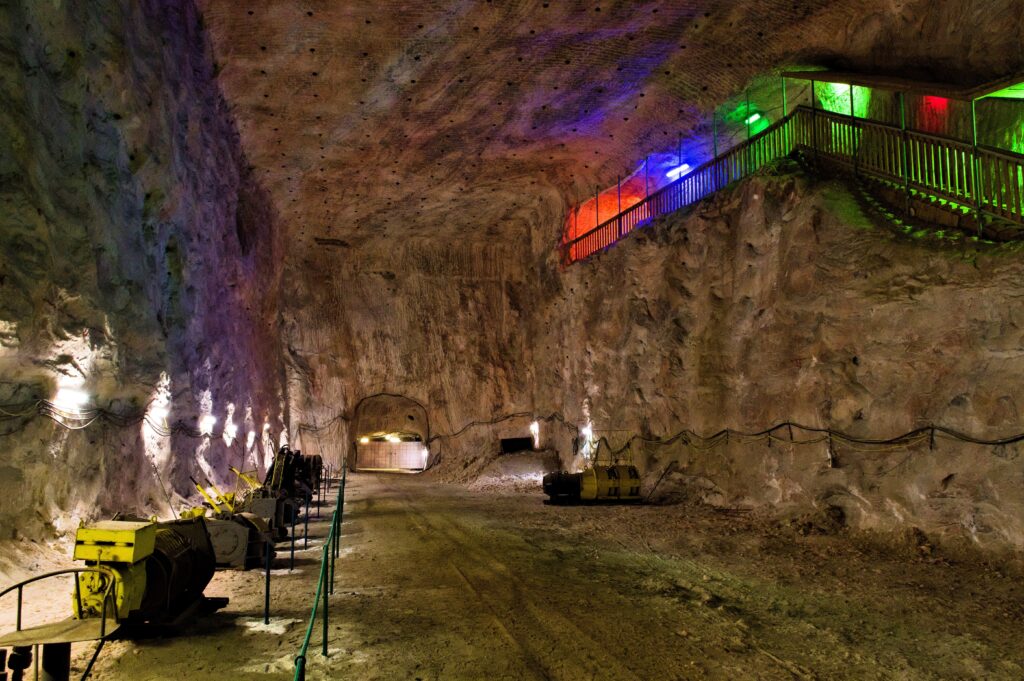
When most people think of salt mines, they probably imagine Wieliczka or Bochnia. While those mines represent centuries of history, Kłodawa offers a very different experience. The Kłodawa Rock Salt Mine is primarily a fully operational modern facility rather than a museum or open-air exhibit, where you can meet real miners. In fact, most of Poland’s road salt comes from Kłodawa.
The mine features the world’s deepest tourist route. Visits are only possible with a guide and at set times, which should be checked on the mine’s website. Plan to spend about three hours on the tour, plus some time in the mine shop. You’ll descend in a genuine mining elevator, often accompanied by miners – don’t forget to greet them with “Szczęść Boże” (God bless), as mining tradition dictates. The mine is extraordinary, carved entirely from solid rock salt. There are no narrow tunnels; instead, you’ll often encounter vast underground caverns. You’ll also see that salt isn’t always white – it can be pink or even blue.
A basilica among the lakes
Visible from kilometres away, the golden dome of the Basilica of Our Lady of Licheń makes the town unmistakable. The basilica is the largest church in Poland and the sixth largest in the world by volume. Completed in 2004, it commemorates apparitions from 1813 and 1850. Its architecture combines elements of classical, Baroque, and Renaissance styles, alongside entirely modern features. One thing is certain: the basilica is enormous. Its tower reaches 142 metres, nearly as tall as the Strasbourg Cathedral tower and taller than the tower of Vienna Cathedral.
The interior is equally astonishing. Allow plenty of time to explore it. Highlights include Poland’s largest organ, an altar carved from famous Carrara marble (Michelangelo sculpted a similar one), and pews styled to resemble the wings of the hussars. Amid all this grandeur hangs a small painting of the Virgin Mary, which once stood in the nearby forest – the site of the apparitions – and remains the most important object in the Licheń sanctuary.
The basilica grounds offer a wide range of attractions, both devotional and recreational. Stroll the paths to visit Golgotha, a nativity stable, or the bell tower for an excellent viewpoint. Additionally, there are at least four restaurants and bars, a pilgrims’ house, and numerous shops selling devotional items and souvenirs.

Where Napoleon never arrived
From Licheń, the road leads to Ślesin, a town best known as a centre for water sports and summer recreation. Nestled between two sizeable lakes, it boasts excellent beaches and one of the best marinas in the Wielkopolska Region for boats and yachts.
And Napoleon? He was supposed to pass through Ślesin during his campaign to Russia – but he never actually did. In his honour, the townspeople erected a triumphal arch, somewhat smaller than Paris’s Arc de Triomphe, but certainly worth seeing. You can also spot Napoleon in the park by the lake, watching over the area from his statue.
Konin
An elephant at the castle
Konin is truly three cities in one: the Old Town along the Warta River, the modernist industrial centre with its steelworks and power plant, and the intimate district of Gosławice. Here you’ll find the Gothic St Andrew’s Church and the castle – formerly the residence of the bishops of Poznań, and now home to the Regional Museum. Inside, several fascinating exhibitions await, including an archaeological display featuring a large forest elephant as the main attraction. The museum also houses old mining machinery and an ethnographic open-air collection.


The oldest road sign in Poland
Exploring Konin’s Old Town is best started at St Bartholomew’s Church, dating back to the 14th century. Its polychromes were painted by Eligiusz Niewiadomski, later known for the assassination of President Narutowicz.
In front of the church stands a sandstone road pillar from 1151, marking the halfway point between Kalisz and Kruszwica. It is the oldest road sign in Poland and one of the oldest in this part of Europe.
From the church, head north towards the Warta River and the centre of old Konin. Along the way, admire the classicist town hall and the former market square, now called Plac Wolności (Freedom Square). Notice the historic townhouse – the former Lithuanian Hotel – and at number 16, the Jan Zemełka townhouse, a preserved brick building that today houses the tourist information centre.
End the tour at the Warta Boulevard. In summer, it’s bustling with pedestrians, while the river is filled with boats as the Great Waterway Loop of Wielkopolska passes through Konin. This is also the perfect time to visit nearby cafés. We recommend sitting in a terrace garden with a view of the Warta River and enjoying a meal. For the best combination of cuisine and views, try Pizzeria Tutti Santi or Rogatka, built on the site of the former city gate.

Turek
At the turn of the 20th century, Turek was a bustling center for weaving and clothmaking. The discovery of lignite coal in the mid-1900s shifted the town toward industry, but today, Turek is all about its unique “Mehoffer atmosphere”—a place defined by the incredible legacy of renowned artist Józef Mehoffer.
The absolute crown jewel here is the early 20th-century Church of the Sacred Heart of Jesus, filled with breathtaking stained glass, polychromies, and oil paintings designed by Mehoffer himself. Outside of Kraków, you won’t find a larger or more valuable collection of his sacred art anywhere in Poland.
A visit to the Józef Mehoffer Town Museum is an absolute must. It all started with an exhibition titled “Józef Mehoffer – Famous and Unknown,” which launched the broader “Turek – A Town in the Spirit of Mehoffer” initiative. This ambitious project brought stained-glass designs left unfinished in the 1930s to life inside the church and revamped the old town hall into a modern museum space. Today, the exhibition “Józef Mehoffer’s Turek Work” lets you dive straight into the Kraków master’s creative world. Spread across five striking “red rooms,” you’ll find the original sketches and full-scale design cartoons created for the church’s murals and stained glass.