It is the only remaining preserved island in Poznań, surrounded by the waters of the Warta and Cybina rivers. The site holds exceptional significance for Polish history, as it was here that the powerful Poznań stronghold once stood, where Duke Mieszko I built his palatium, a stone residence adjoined by a small chapel, likely the first Christian church on these lands..
Residence of the first rulers
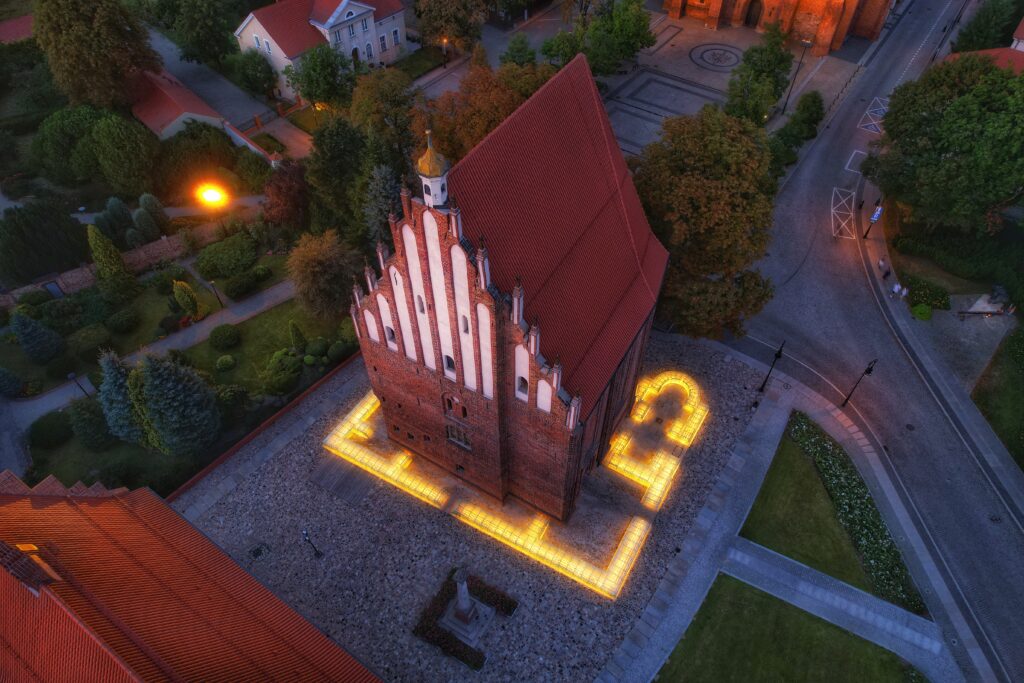
The remains of the ducal residence lie buried deep underground, with the structure of the Church of the Blessed Virgin Mary rising above them. The outline of the palatium (stone residence) is marked by a tempered-glass art installation. The church itself is also intriguing, with a multimedia exhibition inside that brings the history of the site to life. A massive stone is embedded in the northern wall of the church. According to legend, this is the ducal throne from the era of the founders of the Polish state, which visitors are welcome to try.
Another curious feature is a stone set into the eastern wall of the church, marked with a series of deep vertical grooves. According to one legend, they were left by the devil’s claws; another claims they were made by knights sharpening their swords..


Cathedral
The central landmark of Ostrów Tumski is the Poznań Archcathedral Basilica of St Peter and St Paul. The cathedral was established as early as the time of Mieszko I, when the first Polish bishop, Jordan, arrived at his court. The remains of the earliest buildings can still be seen in the underground chambers, which are open to visitors.
The present structure is largely Gothic, a result of post-war reconstruction. The original forms, however, have been preserved in the twelve chapels surrounding the nave. Among these, the Golden Chapel stands out; built in a richly Byzantine style, it houses the neo-Gothic sarcophagus of Mieszko I and Bolesław I the Brave.
Archdiocesan Museum
A visit to Ostrów Tumski would not be complete without stopping at the Archdiocesan Museum, which houses collections of sacred art and liturgical vestments. Among its most notable objects are one of the oldest monstrances in Poland, commissioned by King Władysław Jagiełło, and St Peter’s sword, a gift from the Pope to Mieszko I. A short distance away is the Genius Loci archaeological reserve, showing the remains of the cathedral island’s ancient fortifications from both the Piast period and the late Middle Ages.