Drawa National Park was established in 1990 to protect the post-glacial landscape along two rivers: the Drawa and its tributary, the Płociczna. It’s one of the youngest national parks in Poland, located on the borderland of three voivodeships: Greater Poland (Wielkopolska), Lubusz and West Pomeranian.
Forests cover as much as 80 percent of the park, including pine, beech, oak-beech, alder, riparian, and swamp forests. However, the true treasure of the area are its waters. The largest and most diverse in terms of landscape is Lake Ostrowiec, but the most intriguing is Lake Czarne. It formed 10,000 years ago after a massive chunk of ice, separated from the retreating glacier, melted. The lake has no outlet, and moreover, it’s situated in a deep basin. As a result, the wind never mixes the lake water down to the bottom, and below a depth of 13 meters the lake is practically lifeless, with only anaerobic bacteria living there. This explains the dark color and 7-meter transparency of the water. There are 20 lakes of various types in the park: dystrophic, eutrophic, and mesotrophic.
The highlight of the park is the Drawa River, which is beloved by kayakers for its scenic beauty and fast current, with a flow of 15 cubic meters of water per second. The Drawa flows into the Noteć near Krzyż Wielkopolski, from where you can continue your trip along the wonderful Great Waterway Loop of Greater Poland.
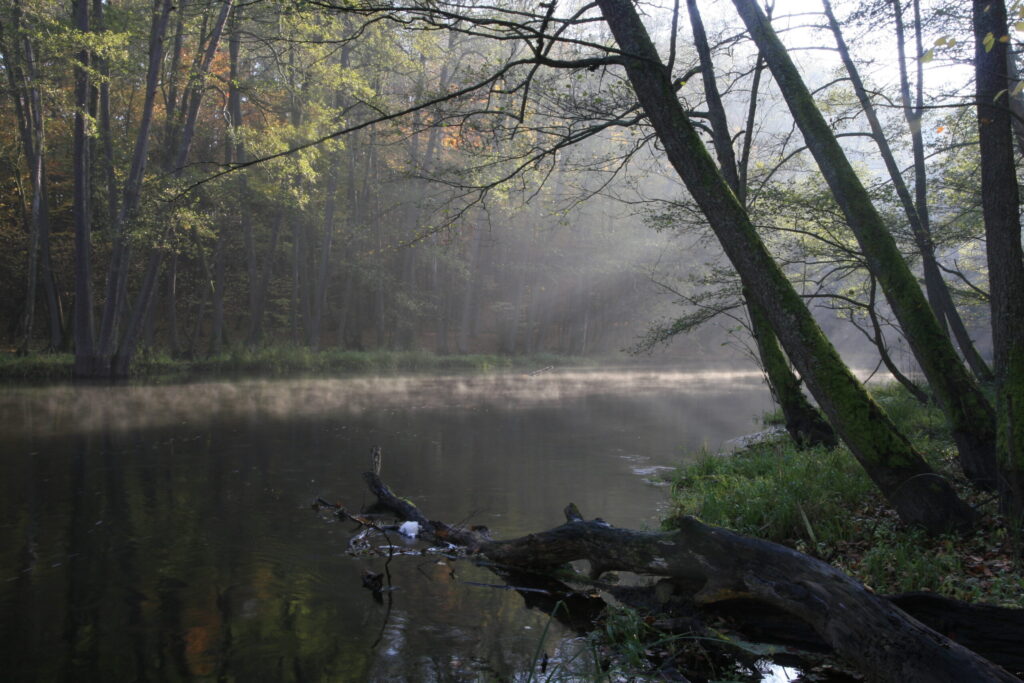
A unique phenomenon occurring in the park are groundwater discharges. There are three types: springs, seeps and seepages. In such places, the spring-fed fens naturally develop. A botanical rarity is the heather-like shrub Chamaedaphne calyculata (commonly known as leatherleaf or cassandra), which usually doesn’t occur at such low latitudes, and is considered a post-glacial relic in Poland. Moreover, a wide variety of mosses and fungi can be found in the park, including rare edible morel (Morchella esculenta), coral tooth fungus (Hericium coralloides) and reishi mushroom (Ganoderma lucidum). A characteristic animal of this region is the European otter, featured in the park’s logo, but beavers, white-tailed eagles, cormorants, and common mergansers can also be found here. The park’s fish are also worth mentioning. There are such rarities as brown trout, grayling, common minnow, European bullhead and bull trout. Interestingly, efforts are currently underway to bring back salmon populations in the Drawa and Płociczna, stocking them with fish bred in Latvia’s Daugava River. What’s more, there are also two small hydroelectric plants on the Drawa: in Borowo and Głusko.
Tourist services are provided by two information centers in Drawno and Głusko. Entrance to the park is free, though kayaking, fishing, and camping require paying a fee. Please note that kayaking along the military training section of the river is prohibited.