Did you know that the Wielkopolska Region has two historic capitals? One is, of course, Poznań, and the other, located in the south, is Kalisz. In the Middle Ages, the two strongholds competed with one another, and later – separated by the borders of the partitions – they developed in different ways: one became the capital of the Grand Duchy of Poznań, while the other emerged as an important industrial and cultural centre of the Kingdom of Poland. The Polish writer Maria Dąbrowska wrote about Kalisz in her novel Nights and Days. Today, we invite you on a two-day, one-night trip to Kalisz, as a weekend in this city is an ideal way to explore the Wielkopolska Region.
Kalisz can be reached easily from Poznań, Łódź, or Wrocław, as the city lies at a similar distance from the capitals of all three voivodeships – an ideal location! The easiest way to get there is by car, but you can also take the train. Just keep in mind that the railway station is quite a distance from the city centre. It’s best to leave your car near the green belt formed on former fortifications, known as planty – yes, like Kraków, Kalisz has its own planty. The city is fairly large but compact, making it perfect for exploring on foot.


A meeting with legends
Speaking of the planty, be sure to visit the only remaining fragments of the city’s fortifications from the time of Casimir the Great. The most significant relic from this period is Dorotka Tower. Its name comes from a legend in which Dorotka – the daughter of the starost – was imprisoned there as punishment for loving a poor shoemaker. You can learn this and other legends at the Kalisz Centre of Fairy Tales and Legends, located within the tower. Dorotka herself can be ‘met’ at the top of the tower, while the shoemaker Marcin can be found in the small square in front.
Unfortunately, Kalisz Castle has not survived to the present day; only its foundations remain, which can be seen on Zamkowa Street. This street will lead you to the Main Market Square, the true heart of the city – an ideal spot for a coffee break. Be sure to also visit the Tourist Information Centre in the Town Hall, where, in addition to brochures and leaflets, you can buy authentic Kalisz wafer biscuits known as andruty.
Town Hall and its surroundings
Climbing the Town Hall tower, you can trace the entire history of the city. On the successive floors, you will discover stories and anecdotes from Kalisz, and you can also admire the remarkable historic clock mechanism, which has been keeping time and striking the hours without interruption ever since.
From the Town Hall tower, you get the best panoramic view of Kalisz and beyond. On a clear day, you can see several neighbouring towns, and some claim that, under exceptional visibility, the Karkonosze Mountains can even be glimpsed. You will certainly not miss the tower of St Nicholas Cathedral, a Gothic church adorned with frescoes and stained-glass windows by Włodzimierz Tetmajer. Looking in the opposite direction from the tower, you will spot St Stanislaus’ Church and the Franciscan monastery. Cast your eyes also towards Dorotka Tower – do you see the distinctive dome? That is the Kalisz Orthodox Church. The city lay for over a century on the western frontier of Russia (with the tsars’ authority extending as far as Alaska), so this is hardly surprising.


A stroll along the Prosna River
For the next part of the day, head towards the Prosna River, which flows through Kalisz. Start with the Stone Bridge – the oldest bridge in Kalisz and one of the oldest in Wielkopolska. Nearby, you will also find the Kalisz Philharmonic building and the historic Villa Calisia.
From there, the best option is to take a stroll to the City Park, the oldest public urban park in Poland. One of the most beautiful buildings in the city is the Bogusławski Theatre, and the best view of the theatre can be enjoyed from the park itself.
Kalisz Stronghold
The weekend in Kalisz continues! Start the second day with a visit to the stronghold at Zawodzie, which lies along the Piast Route. This was once the original location of Kalisz before the town was moved to its present site. Today, Zawodzie is an archaeological reserve, where you can see a reconstruction of the defensive rampart and tower, houses inhabited during the Piast era, and the remains of the stronghold church. The reconstructed houses include those of a saddler, a komes (local noble official), a widowed weaver, a servant, a knight, a blacksmith, and a potter. Just outside the stronghold stands the wooden St Adalbert’s Church, a saint whose figure holds great significance for Kalisz.

In the footsteps of the Industrial Revolution
The process of industrialisation around Kalisz can be explored primarily in Opatówek, located 10 kilometres east of the city centre. The History of Industry Museum is housed in the historic factory of Adolf Fiedler – the only preserved industrial building complex in Europe from the first half of the 19th century where visitors can trace all stages of production, from raw material to finished product, as well as the architectural solutions used in industry at the time.
Within Kalisz itself, a particularly interesting site is the former Calisia piano factory, founded in 1878 by Arnold Fibiger and for many years the largest producer of pianos in Poland. After years of decline, Calisia has been given a new lease of life as an elegant hotel with several restaurants.
Gołuchów Castle
No trip to the Kalisz area would be complete without a visit to Gołuchów Castle. This exquisite and lavish residence resembles the Renaissance castles of the Loire Valley. This is hardly surprising, given that the plans for reconstructing the old castle were drawn up by the French architect Eugène Viollet-le-Duc, best known for his work on the restoration of Notre-Dame Cathedral in Paris and the fortifications of Carcassonne. The project was commissioned by Izabella Działyńska, née Czartoryska, a great patron of the arts.
The castle interiors primarily function as a museum. Today’s exhibition is a blend of Izabella Czartoryska’s collections – including the most famous and the largest collection of ancient Greek vases in Poland – together with other holdings of the National Museum in Poznań, of which the castle is a branch.
Gołuchów Castle is surrounded by the largest palace park in Wielkopolska, home to around 600 different species of trees and shrubs. The park also features ponds, wooden bridges spanning the river, and picturesque rock gardens. It is also home to the Forest Culture Centre, managed by the State Forests. The museum collections are displayed in the former farm buildings: the outhouse, sheepfold, carriage house, and cattle shed. However, the greatest attraction for visitors is the bison demonstration enclosure.

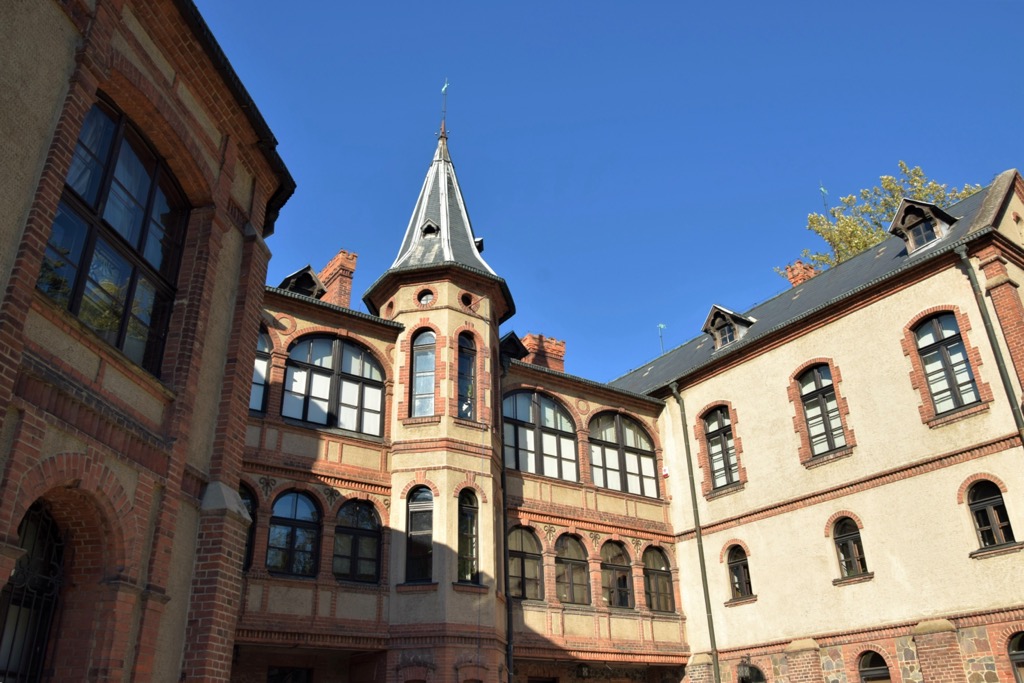
Antonin Palace
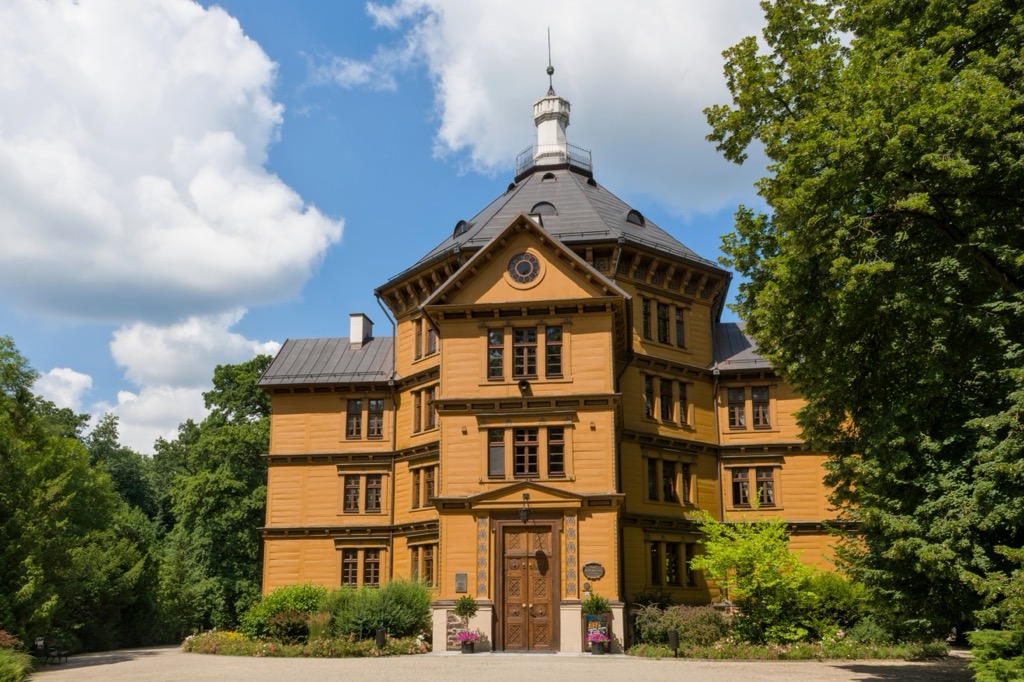
Closer to Ostrów Wielkopolski, near the picturesque Barycz Valley, stands one of the most unique buildings in Wielkopolska: the Antonin Palace. Constructed in timber and a half-timbered style, it is painted in the distinctive ‘imperial yellow’. Although it was conceived as a hunting lodge rather than a permanent residence, its elegant design continues to impress. Yet what truly makes Antonin exceptional is not only its architecture, but also its music. Every year, the palace hosts the international ‘Chopin in the Colours of Autumn’ festival.
The palace was built for Prince Antoni Radziwiłł, governor of the Grand Duchy of Poznań. A talented musician himself, the prince often hosted Frédéric Chopin at the palace, where the latter performed alongside him and composed several pieces for the prince.
Today, visitors can experience the palace as Chopin once did, with overnight accommodation available. The building houses a hotel and a restaurant, and regularly hosts intimate concerts.

Nowe Skalmierzyce
Although Nowe Skalmierzyce is a relatively small town, the scale and grandeur of its railway station can be surprising. It was built on the former border between the German Empire and Russia.
The grand opening of this impressive building, a symbol of Prussian power, took place in 1909. The station is adorned with a tall tower topped with a spire, flanked on both sides by turrets decorated in the Gothic style. In the past, it featured Italian marble and luxurious chandeliers. As a border and representative station, it hosted meetings of state delegations, including talks between Emperor Wilhelm II and Tsar Nicholas II.
Lewków Palace
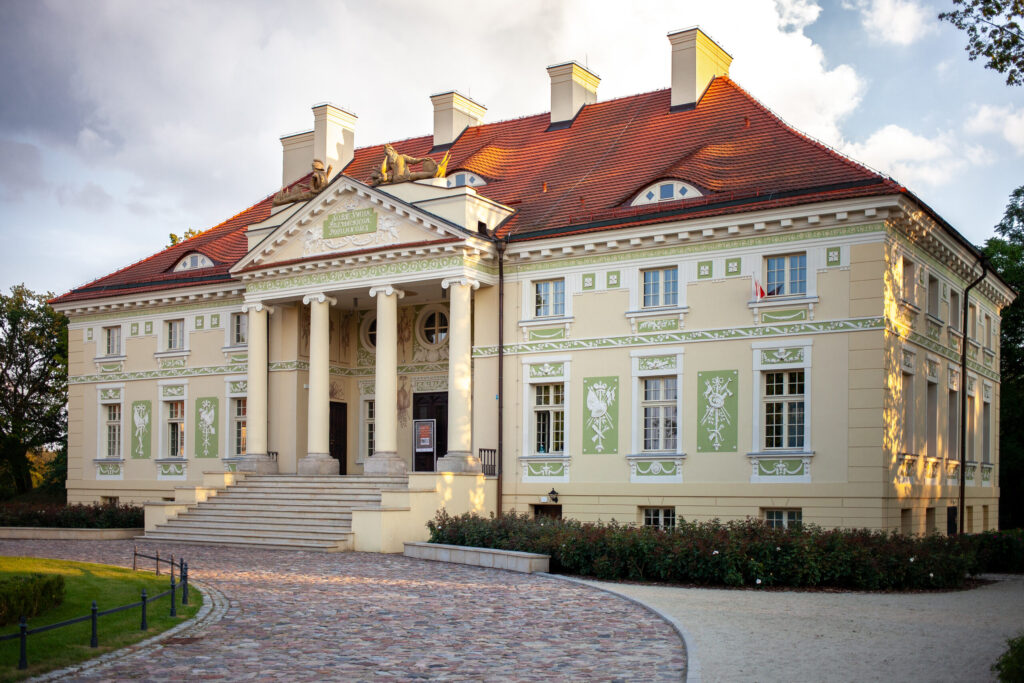
Located near Ostrów Wielkopolski, the Lewków Palace is one of the most beautiful and best-preserved manor residences in Wielkopolska, captivating visitors with its classical harmony. Following a meticulous renovation, it now shines in full splendour and awaits tourists. The palace is surrounded by an extensive park, where visitors can also relax at the atmospheric palace café.
The palace interiors include salons, the owners’ bedrooms, and representative halls. The walls feature preserved illusionistic paintings depicting imagined landscapes from ancient Rome, Greece, and Egypt.
The surrounding park offers a stroll of up to two hours, featuring a pond with an island, an orangery, and small architectural elements typical of romantic landscape parks. Visitors can rest in the palace café, located on the ground floor. Tours of the palace are available both individually, with an audio guide, and with a professional guide.
Kobyla Góra
The Tatra Mountains have Rysy, the Karkonosze Mountains have Śnieżka, and the Wielkopolska Region has Kobyla Góra. Although its 284 metres may not seem particularly impressive, reaching the summit is truly worthwhile. Kobyla Góra is the highest peak in the Ostrzeszów Hills and the tallest point in Wielkopolska. It is a remnant of glacial activity from the last Ice Age, around 180,000 years ago.
Partially forested, the summit now serves a religious and pilgrimage function, featuring a 20-metre cross, among other things. The hike is best started from one of the two neighbouring villages: Parzynów or Kobyla Góra.